
Anyone visiting Thailand is immediately struck by the warmth and gentleness of the population.
It’s a country where smiles are all-pervasive, people are invariably polite and kind-hearted, and no one uses harsh words or raises his or her voice in conversation. The Thais always appear eager to be helpful and accommodating, and foreigners feel that they are warmly welcome. Even the traffic (often unbearably slow at rush hour in large cities such as Bangkok) doesn’t lead to honking or excited gestures, as would be the case in most other countries.
How much of this is truly genuine, and how much of it is just a show reserved for public displays? How do Thais behave behind closed doors? Do they act differently when they are amongst themselves vs. when farang (foreigners) are around? And where does all this gentleness come from?
As it turns out, what you perceive when you arrive is very much reality – the Thais are genuinely considerate and kind, not only towards tourists, but even more so when they are amongst themselves. And it’s nothing new – the first European visitors who arrived in this country as far back as the XVIth century already remarked the “extraordinary civility” of the Siamese (Siam was the name of Thailand until 1939). The French envoy La Loubère, who visited Thailand and the rest of Southeast Asia in the XVIIth century, enthusiastically wrote a lengthy report on the “extraordinary good nature and manners” of the Siamese.
Any visitor from Europe or the US will quickly feel how different interpersonal relations are in Thailand to what he or she is accustomed to in the West.
Greetings
In Western cultures we typically use a handshake as greeting. This gesture involves a firm grip and often direct eye contact, signifying confidence and straightforwardness (the origin of the handshake in the West is actually very practical – it served as way to show someone you were meeting, that you were not carrying a knife or a sword).
In some Western countries, hugs and cheek kisses are also common amongst friends and family. The emphasis in Western greetings is on equality and personal space, with less attention to hierarchical distinctions.
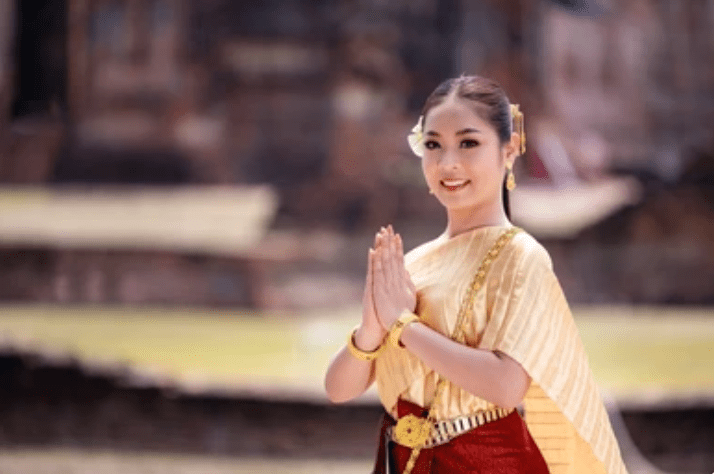
By contrast, the traditional Thai greeting is the wai, a gesture of pressing the palms together with fingers pointing upwards, accompanied by a slight bow. The height at which the hands are held and the depth of the bow vary depending on the person’s age and social status. The wai is a sign of respect and is used for saying hello, goodbye, and thank you. Direct physical contact, like handshakes or hugs, are discouraged, especially in formal settings.
Beyond politeness, the Thais also say something about what they value when they greet you – one of the most common ways to address people, even those you don’t know, is to ask Khun sabaidii?, meaning “Are you happy?”, which stands in sharp contrast to “Hello!”, the usual Western greeting.
Communication
In the West people are encouraged to express their opinions openly and assertively, even if it leads to disagreement, and communication is generally quite direct and straightforward. It’s a style that reflects a cultural emphasis on assertiveness and individualism. Clear and explicit communication is valued, whereas ambiguity is generally discouraged.
By contrast, Thai communication tends to be indirect and nuanced, aiming to preserve harmony and avoid confrontation. Thais often use non-verbal cues, such as facial expressions and tone of voice, to convey messages. Silence or non-committal responses like “maybe” or “we’ll see” will usually be used to indicate disagreement or refusal, in the hope that this way of expressing oneself will avoid causing offence. This indirect style is rooted in the cultural value of saving face, which involves maintaining one’s dignity and that of others.
In Thai culture, direct eye contact can be considered disrespectful or aggressive, particularly with someone older or of higher status. It’s generally considered more polite to avoid prolonged eye contact and instead to look slightly downward. This shows respect and humility.
In contacts with foreigners, Thais will be careful not to offend. To avoid any difficulties or misunderstandings due to language barriers, Thais will seek to compromise, so conversations might sometimes come across to visitors as being unnecessarily short.
Hierarchy
Thai society places a strong emphasis on respect and hierarchy. Age, social status, and position determine the level of respect shown to individuals. For example, younger people are expected to show deference to elders, and employees are expected to respect their superiors. This hierarchical structure is evident in various aspects of daily life, from language use to social interactions.
While respect is also important in Western cultures, there is a greater emphasis on equality and informality. Social hierarchies are less pronounced, and people are often addressed by their first names, regardless of age or position. The use of formal titles is typically reserved for specific professional or ceremonial contexts. Western societies tend to value egalitarianism, with an emphasis on treating everyone equally.
Body language
In Thailand, body language plays a crucial role in communication. Certain gestures and actions have specific cultural meanings. For example, touching someone’s head is considered disrespectful, as the head is regarded as the most sacred part of the body. Conversely, pointing feet at people or religious objects is seen as highly offensive. Public displays of affection are generally frowned upon, and maintaining a calm demeanor is strongly valued.
In Western cultures, body language is more varied and context-dependent. Touching the head is not typically seen as disrespectful, and public displays of affection are more accepted, especially in informal settings. Gestures like pointing with a finger are common and not considered offensive. Westerners often use body language to express emotions and reinforce verbal communication, such as smiling to indicate friendliness or making eye contact to show attentiveness.
Humility and modesty
Thai social interactions are characterized by a strong emphasis on politeness and non-confrontation. Thais prefer to maintain harmony and avoid direct conflict. Social norms dictate that people should be courteous, avoid raising their voices, and refrain from openly criticizing others. Humility and modesty are strongly valued traits, and boasting or showing off is strongly discouraged.
In Western cultures, social interactions are often more informal and assertive. People are encouraged to express their opinions and engage in open discussions, even if it leads to disagreement. Confidence and self-assurance are valued, and individuals are often praised for their achievements. While politeness is important, there is a greater acceptance of direct communication and constructive criticism.
Dress codes
Modesty in dress is an important aspect of Thai etiquette, especially in religious and formal settings. When visiting temples or government buildings, shoulders and knees should be covered. Shoes must be removed before entering someone’s home or a sacred space. The concept of dressing appropriately for the occasion is deeply ingrained, and traditional clothing is often worn during cultural ceremonies and festivals.
Western dress codes are more flexible and contextual. While formal attire is expected in professional and ceremonial settings, casual wear is widely accepted in everyday life. The emphasis is on personal style and comfort, with a broad range of acceptable clothing options. In the last decades in Western countries, there is a strong trend towards casual work environments, with T-shirts and sneakers becoming the norm, in settings where until recently jackets and ties would have been present.
Dining
Dining in Thailand is often a communal activity, with dishes shared among everyone at the table. Food is brought in all at once, not in steps (as in the West) and it is polite to wait for the eldest person to start eating before beginning your meal. Forks are used to push food onto a spoon, which is then brought to the mouth, and knives are not generally in use. Until recently it was considered respectful to leave a small amount of food on your plate to indicate that you are full. This situation has evolved somewhat, with “doggybags” becoming more common.
In Western cultures, individual plates are the norm, and it is customary to finish all the food on your plate as a sign of appreciation. Forks and knives are used, with specific rules on how they should be held and utilized during the meal. Dining etiquette emphasizes manners such as not speaking with your mouth full, using napkins properly, and engaging in polite table conversation. While communal dining is also present, especially during family gatherings or social events, the emphasis on individual portions and place settings is much more pronounced than in Thailand.
Conflict resolution
The Thai approach to conflict resolution is heavily influenced by the cultural value of maintaining social harmony. Thais prefer to avoid direct confrontation and to seek compromise and mediation. Problems are often addressed indirectly, and efforts are made to ensure that no one loses face. This approach is reflected in the use of soft language, non-verbal cues, and the involvement of respected intermediaries to help resolve disputes.
In contrast, Western cultures often adopt a more direct and assertive approach to conflict resolution. Open discussions and negotiations are encouraged, with an emphasis on finding fair and practical solutions. Individuals are expected to stand up for their rights and to express their grievances clearly and directly. Mediation and compromise are also valued, but there is a greater acceptance of direct confrontation if necessary to resolve conflicts effectively.
The role of Buddhism
It is Buddhism that lies at the heart of Thailand’s cultural manners (94% of the Thai population professes to be Buddhist).
Buddhism emphasizes humility and respect for others, which is so evident in Thai manners. As noted above, Thais generally avoid confrontation and strive for harmonious interactions, aligning with the Buddhist principle of non-violence (ahimsa). Acts of kindness and generosity, known as “making merit,” are highly valued in Buddhism. This has a direct impact on people’s day-to-day behaviour in the sense that Thais will go out of their way to be helpful and to do good deeds, because it is believed that such acts will generate “positive karma”, leading to a better reincarnation in the next life.
The role of family, schools and the media
The teaching of manners in Thailand starts at a very early age and continues throughout life. Families, schools as well as the media put a strong and constant emphasis on encouraging children to adhere to “appropriate” social manners.
In childhood, this can sometimes be accompanied by physical punishments, but the use of domestic violence is generally frowned upon. Thais parents will always try to privilege non-violent forms of discipline, in line with Buddhist thinking. Violence among adults is strongly against social norms and will almost never happen in public.
Many guidebooks are in circulation to help parents and schoolteachers in their daily jobs to transmit cultural values. Some publications, such as “The Qualities of a Gentleperson”, which was written in the 1930’s, is still very much in use today.
Apologies
If there are differences, Thais will always try to manage them in private, never in public. In general, if they feel grieved, Thais will take their time to respond and first seek to work on themselves by calming down through breathing exercises and meditation. Next, they will try to understand what might have caused someone to act in a certain way, before blaming them. Only after a certain time and abundant introspection, will Thais approach the person in question. In doing so, they will rarely accuse the other party, but will give indirect hints that they feel aggrieved. Often an apology from the other person will solve the issue amicably.
This leads to a society in which apologies are very common, even if the person who aggrieved another doesn’t quite think that they have done something wrong. In the West, we have more trouble with apologies, which are often considered as signs of “weakness” and where “standing one’s ground” is generally considered positively.
What can we learn in the West from the Thais?
Do the Thais live in a perfect society, one that is free of the kind of social stress we so often feel in the West? Not really. The Thai emphasis on social cohesion and social restraint at all costs, their hierarchical view of individuals and society, the extremely strong emphasis on adhering to group, rather than individual, norms, does lead to unhappiness in those who don’t fit (or don’t want to fit) into the mould. Even though Thai society takes an “everything goes” approach in areas such as sexuality, it will be much more restrictive when it comes down to respect for hierarchy and for the elders. The “behind the scenes” and slow attitude to conflict resolution will work in many circumstances, but not always. And the inability to say clearly and directly what you think, will certainly confuse many people, not just Westerners.
Can we in the West learn from the Thais? Yes, we can. The overt and constant signs of warmth, kindness and gentleness, the sincere welcoming smiles, and the strong emphasis on amicable conflict-resolution, make for a society where you feel very well from the moment you arrive. Even though the foundation of Western culture, with its emphasis on individualism and self-expression, will often stand in the way of achieving the kind of social harmony that is so prevalent in Thailand, we can still, as individuals, learn from what Thais do so well in their every day life, by showing humility, consideration, restraint and kindness to others. There is no doubt that adopting some of the Thai cultural manners will make us in the West lead more harmonious, less stressful and ultimately happier lives.
 Truliluli Travel Reports
Thanks Evelyn and Pedro for your last post which as always is interesting and provides us with views making us traveling in our mind. Though present actuality cannot make us very optimistic with the actual or potential conflicts, even in Asian countries, Buddhist or not, I prefer to comment with a funny story I probably told you before about communication.
´When a diplomat says Yes, he means Maybe 🤔
when a diplomat says Maybe, he means No
and when a diplomat says No, he is not really a diplomat.´
´When a lady says No, she means Maybe 🤔
when a lady says Maybe, she means Yes
and when a lady says Yes, she is not really a lady’.
I don’t know if this story is universal or applies only for western countries. Maybe can you test it with some Thaï relations 😃
All my best for your future experiences
Pierre
LikeLike
Thank you Evelyn and Pedro for this wonderful insight of “manners and culture in Thailand”🙏
Grateful for “learning” from a distance ☺️
LikeLike
Thank you for this valuable insight – it makes you think about it…
LikeLiked by 1 person